深度解析医学证据,DeepEvidence为你支撑决策
2026年欧洲肝病学会年会(EASL 2026)于2026年5月27日在西班牙•巴塞罗那正式开幕。作为全球肝病学领域最具影响力的学术盛会之一,本届大会将汇聚来自世界各地的顶尖专家学者,共同探讨肝病学、胃肠病学、移植外科及传染病学等领域的最新研究进展与临床实践突破。
会议期间,首都医科大学附属北京佑安医院张晶教授团队的一项题为“非侵入性评分识别肥胖减重手术患者显著纤维化及高风险MASH的验证研究”报告在大会亮相。为传递本次大会的精彩看点,肝胆相照平台特将该研究的主要内容整理如下,以飨读者。
研究一 OS-053
非侵入性评分识别肥胖减重手术患者显著纤维化及高风险MASH的验证研究
Validation of Noninvasive Scores for Identifying Significant Fibrosis and At-Risk Metabolic Dysfunction-Associated Steatohepatitis in Obese Bariatric Surgery Patients
▼ 研究背景
代谢功能障碍相关脂肪性肝炎(metabolic dysfunction-associated steatohepatitis, MASH)可显著增加肝脏相关及肝外不良结局的发生风险。本研究旨在验证基于常规临床指标构建的多种非侵入性评分(noninvasive tests, NITs)在肥胖减重手术患者中识别显著肝纤维化及高风险MASH的诊断价值。
Significant fibrosis and metabolic dysfunction-associated steatohepatitis (MASH) elevate risks of adverse liver and extrahepatic outcomes. This study aimed to validate the ability of noninvasive scores (NITs) based on routine clinical indicators to identify significant fibrosis and at-risk MASH in obese bariatric surgery patients.
▼ 研究方法
本研究纳入来自两个独立减重手术队列的360例受试者,收集其肝组织活检结果及常规临床资料。比较以下六种非侵入性评分在诊断显著肝纤维化及高风险MASH中的效能:FIB-4、NFS、APRI、LRS、FNI(由天冬氨酸氨基转移酶、高密度脂蛋白胆固醇及糖化血红蛋白构成)以及FMO(由天冬氨酸氨基转移酶、丙氨酸氨基转移酶、甘油三酯及高密度脂蛋白胆固醇构成)。
This study included 360 participants from two independent bariatric surgery cohorts, and liver biopsy and routine clinical data were collected. The efficacy of FIB4, NFS, APRI, LRS, FNI (combining aspartate aminotransferase, high-density cholesterol, and glycated hemoglobin), and FMO (including aspartate aminotransferase, alanine aminotransferase, triglycerides, and high-density lipoprotein cholesterol) in diagnosing significant fibrosis and at-risk MASH was compared.
▼ 研究结果
表1 患者基线特征
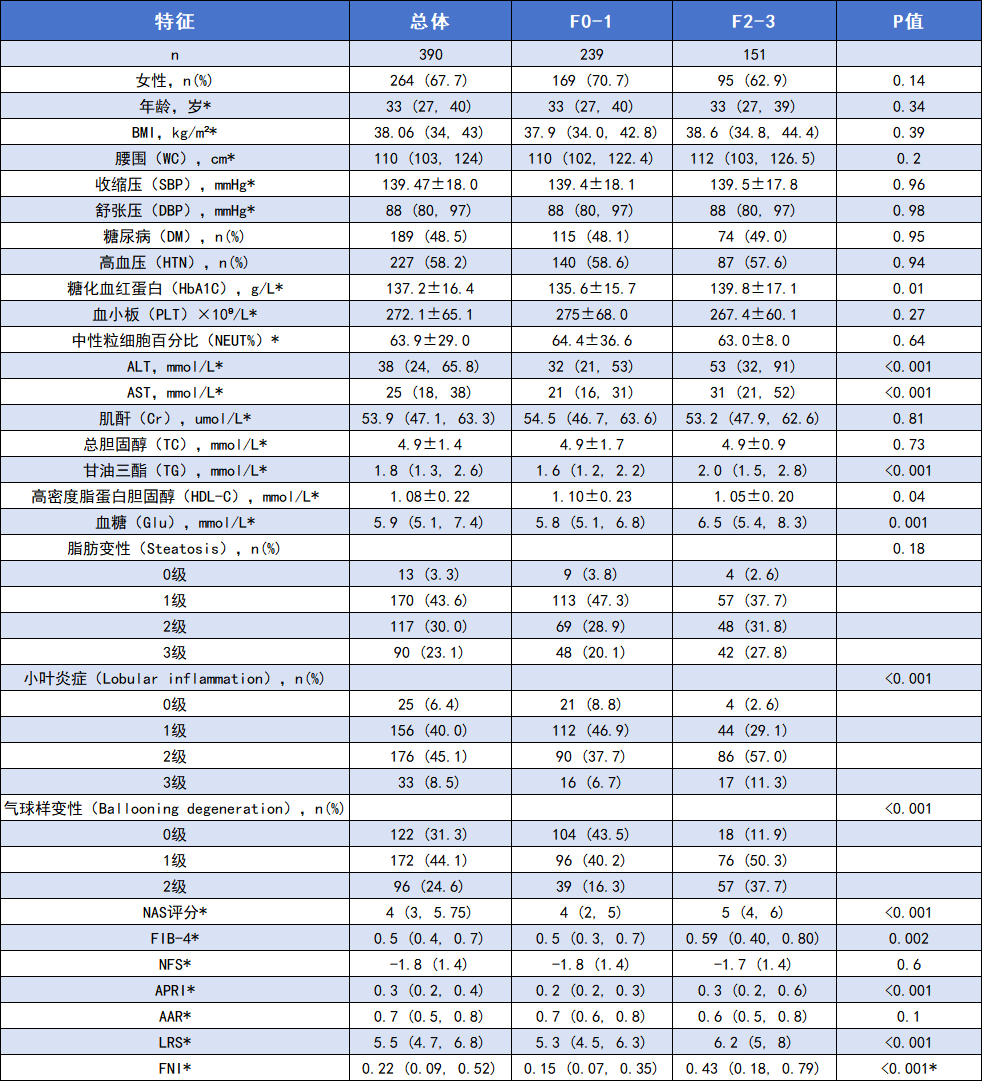
在360例受试者中,152例(38.9%)被诊断为显著肝纤维化,124例(31.7%)被诊断为高风险MASH。
表2 NITs对显著纤维化及高风险MASH的诊断效能表
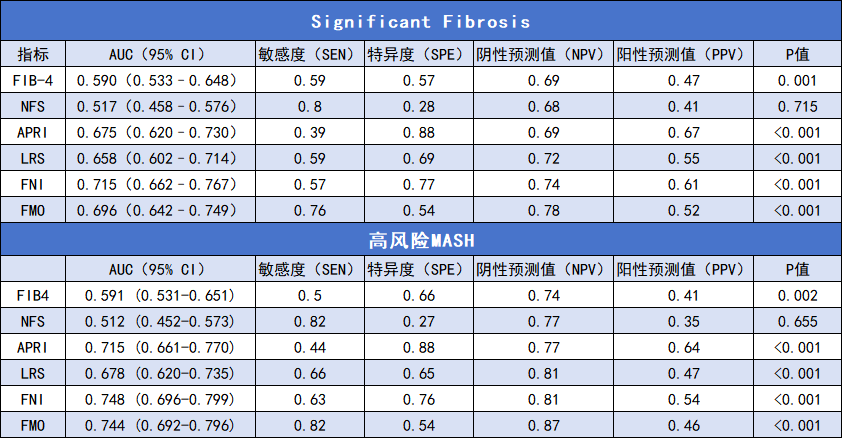
针对显著肝纤维化的诊断,FIB-4、NFS、APRI、LRS、FNI及FMO的曲线下面积(AUC)分别为0.590、0.517、0.675、0.658、0.715及0.696。其中,FNI模型表现出最佳的排除效能(截断值0.10,敏感度87.42%,阴性预测值80.81%),而FMO模型则展现出最佳的纳入效能(截断值0.22,特异度83.61%,阳性预测值60.20%)。
表3 NITs对显著纤维化及高风险MASH的排除与纳入诊断效能
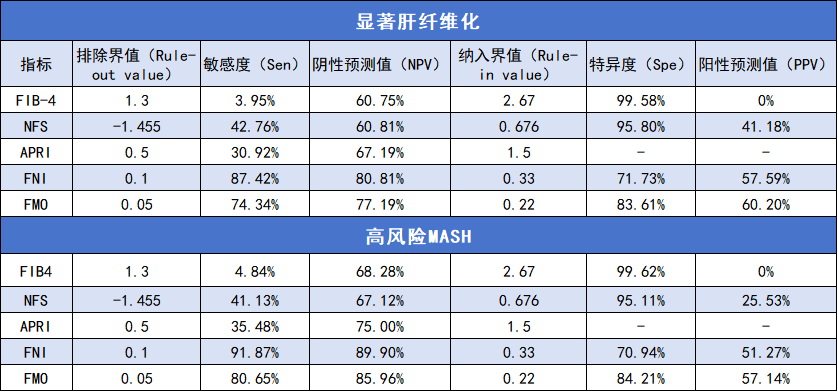
针对高风险MASH的诊断,上述六种评分的AUC分别为0.591、0.512、0.715、0.678、0.748及0.744。FNI同样具有最佳的排除效能(截断值0.10,阴性预测值89.90%),而FMO仍保持最佳的纳入效能(截断值0.22,阳性预测值57.14%)。
Among the 360 participants, 152 (38.9%) were diagnosed with significant fibrosis and 124 (31.7%) were diagnosed with at-risk MASH. The diagnostic efficacy of NITs for significant fibrosis was as follows: the AUC (95% CI) for FIB4, NFS, APRI, LRS, FNI, and FMO were 0.590 (0.533-0.648), 0.517 (0.458-0.576), 0.675 (0.620-0.730), 0.658 (0.602-0.714), 0.715 (0.662-0.767), and 0.696 (0.642-0.749), respectively. The FNI model demonstrated optimal rule-out[cutoff 0.10, sensitivity 87.42%, negative predictive value (NPV) 80.81%] performance, while FMO demonstrated optimal rule-in[cutoff 0.22, specificity 83.61%, positive predictive value (PPV) 60.20%] performance. For at-risk MASH patients, the AUCs for FIB4, NFS, APRI, LRS, FNI, and FMO were 0.591 (0.531-0.651), 0.512 (0.452-0.573), 0.715 (0.661-0.770), 0.678 (0.620-0.735), 0.748 (0.696-0.799), and 0.744 (0.692-0.796), respectively. FNI also demonstrated the best exclusion performance (cutoff value 0.10, NPV 89.90%), while FMO showed the best inclusion performance (cutoff value 0.22, PPV 57.14%).
▼ 结论
FNI是一种准确、便捷且具有良好成本效益的非侵入性评分体系,可有效识别减重手术患者发生显著肝纤维化的风险及MASH的风险。
Conclusion: FNI is an accurate and cost-effective non-invasive scores that can effectively identify the risk of significant and at-risk MASH in patients with bariatric surgery.
综上所述,本研究基于两个独立减重手术队列,系统验证了六种常见非侵入性评分(NITs)在识别显著肝纤维化及高风险MASH中的诊断效能。结果表明,相较于传统的FIB-4、NFS等指标,FNI与FMO两项新型评分模型展现出更优的综合性能。
其中,FNI评分凭借其极高的敏感度和阴性预测值,在临床筛查中可作为可靠的“排除”工具,有效减少不必要的肝穿刺活检;而FMO评分则以较高的特异度和阳性预测值,在“纳入”高风险患者方面表现出明显优势。该研究为肥胖减重手术人群的术前肝病风险评估提供了简便、高效且成本低廉的无创解决方案,有望推动MASH相关肝纤维化的早期识别与分层管理,具有重要的临床应用与推广价值。