首页 > 医疗资讯/ 正文
癫痫(Epilepsy)是一种中枢神经系统(神经元)的疾病,患者会经历突发的电活动异常,这些异常通常导致不同类型的癫痫发作。癫痫的发作可大致分为两大类:全身性发作和局部(局灶性)发作,且其症状范围可以从轻微的失神到剧烈的抽搐。
尽管近年来在癫痫的诊断和治疗方面取得了显著进展,但仍存在一些重要而未解决的临床问题:
-
治疗响应性差异:尽管有多种抗癫痫药物(AEDs)可用,但约30%的患者对现有药物治疗反应不佳,被称为难治性癫痫。这部分患者可能需要更复杂的治疗方案,包括手术或神经调控疗法。
-
诊断挑战:正确诊断癫痫类型对于选择合适的治疗方案至关重要,但在某些情况下,尤其是对于非典型发作或非发作性表现,诊断可能具有挑战性。
-
长期副作用:长期使用抗癫痫药物可能会带来副作用,如骨质疏松、肝脏问题和认知功能受损,管理这些副作用是治疗的一部分挑战。
-
生活质量影响:癫痫对患者的心理健康和生活质量有显著影响,患者可能面临就业困难、社交障碍和驾驶限制等问题。
-
意识和误解:社会对癫痫的误解仍然普遍,患者经常面临歧视和社会隔离。提高公众意识和改变公众对癫痫的态度是长期的社会挑战。
解决这些问题需要跨学科的合作,包括神经科学、药理学、心理学和社会科学的专家。持续的研究努力,旨在开发新的治疗方法、改善诊断工具和提高公众对癫痫的认知,对于提高患者的治疗效果和生活质量具有重要意义。
我们仅对美国国立卫生研究院(NIH)资助的在研癫痫相关项目进行梳理,希望给同仁们的选题思路提供一点启发。
2024年,以“Epilepsy”为检索词、在题目中进行检索,美国NIH针对癫痫的在研有217项。
一,谁获得了这些研究?
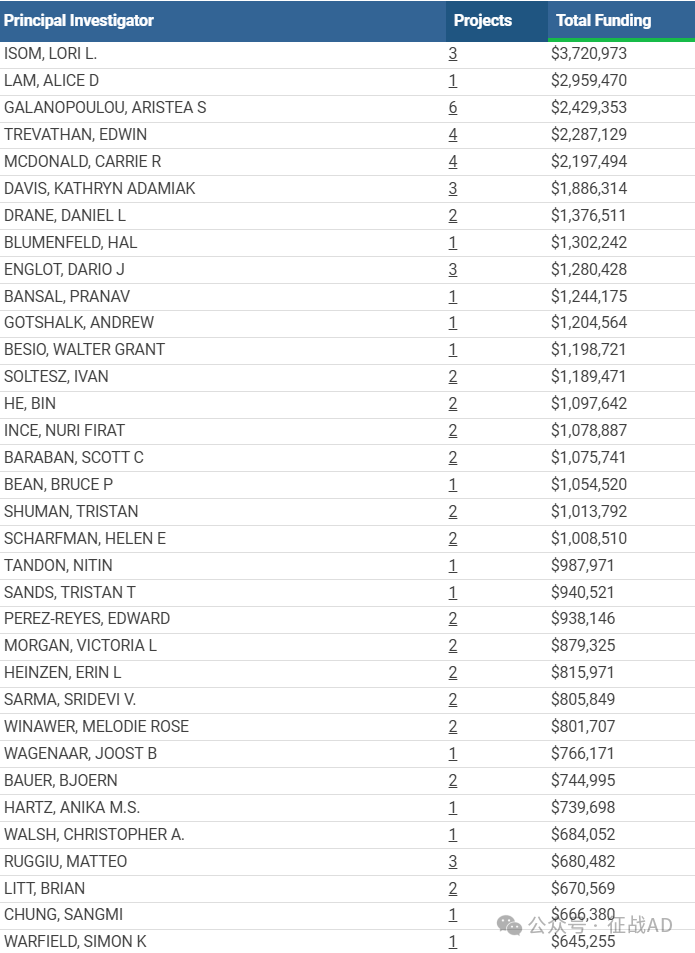
1,在研癫痫基金最多的PI
-
UNIVERSITY OF MICHIGAN AT ANN ARBOR 的 ISOM, LORI L.
-
MASSACHUSETTS GENERAL HOSPITAL 的 LAM, ALICE D
-
ALBERT EINSTEIN COLLEGE OF MEDICINE 的 GALANOPOULOU, ARISTEA S
-
VANDERBILT UNIVERSITY MEDICAL CENTER 的 TREVATHAN, EDWIN
-
UNIVERSITY OF CALIFORNIA, SAN DIEGO 的 MCDONALD, CARRIE R
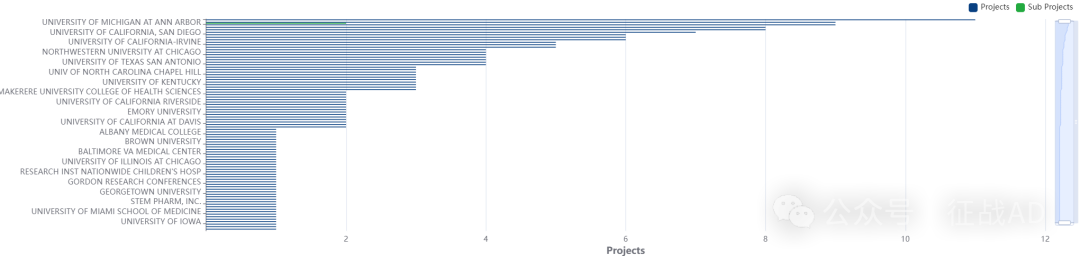
2,癫痫基金最多的研究机构
-
麻省总医院
-
范德堡大学医学中心
-
密歇根大学安娜堡分校
-
加州大学圣地亚哥分校
-
宾夕法尼亚大学等
二,癫痫研究热点是什么?
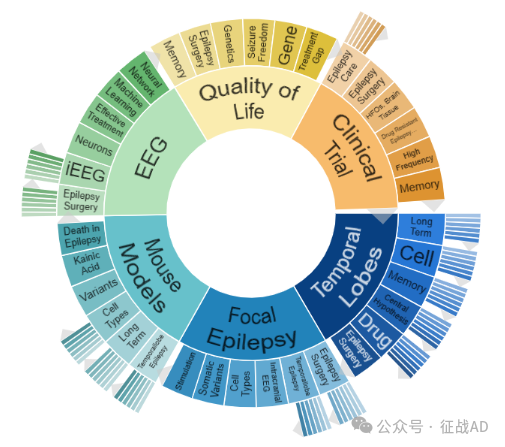
癫痫研究领域总览(根据关键词)
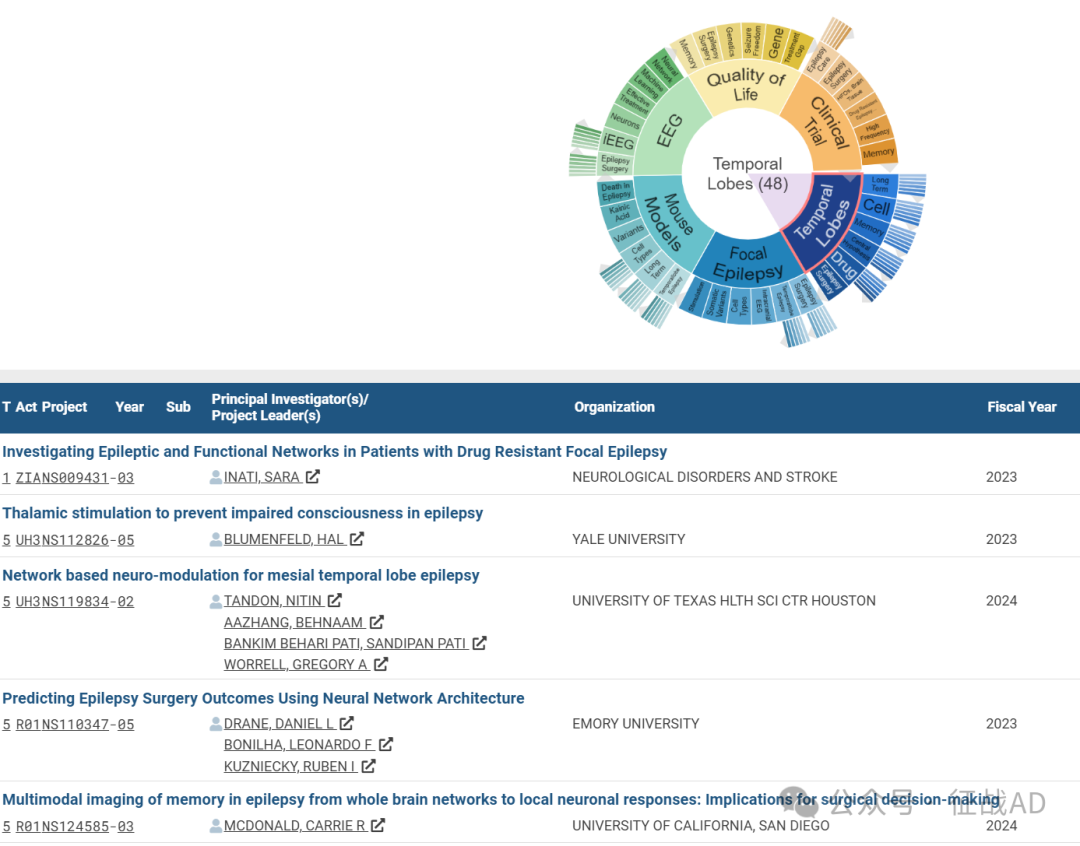
A,关于颞叶(Temporal Lobes)的研究项目最多
有 48 项在研基金涉及到了颞叶,关注最多的方面包括长期(Long Term)、细胞(Cell)、记忆(Memory)、中心假说(Central Hypothesis)、药物(Drug)、癫痫手术(Epilepsy Surgery)等研究。
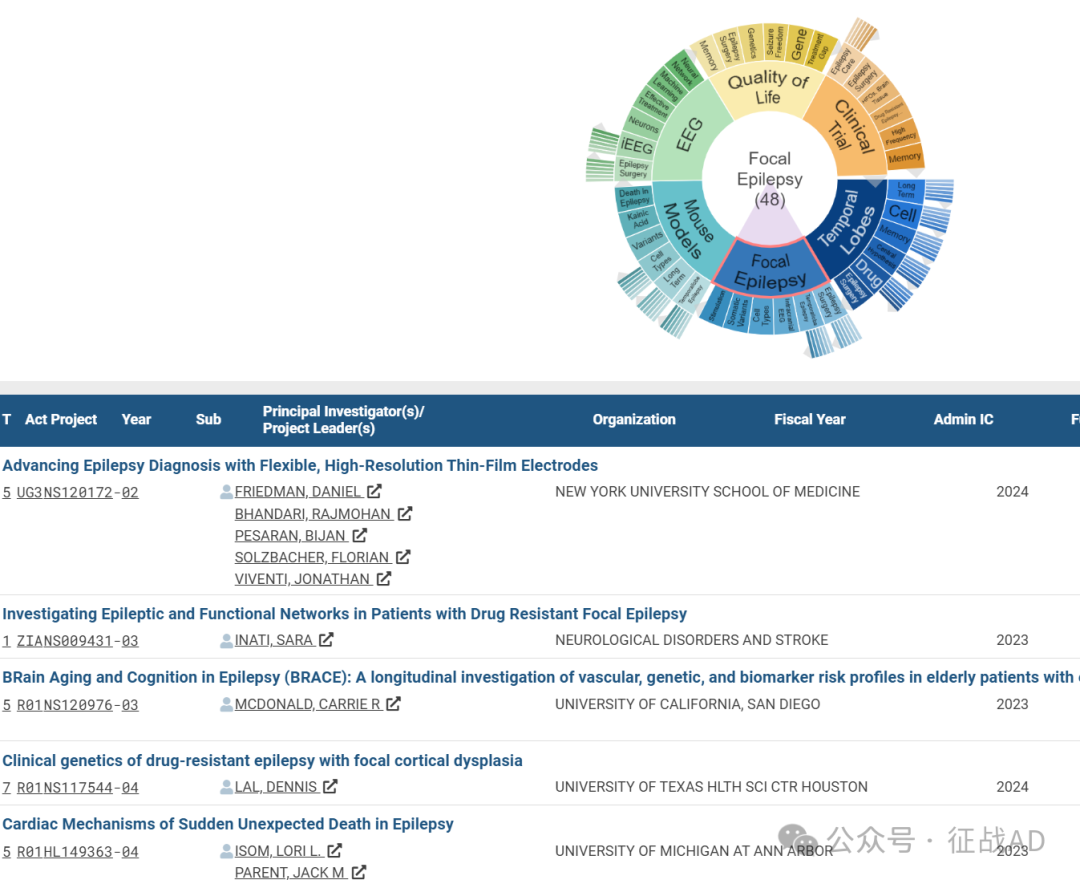
B,关于局灶性癫痫(Focal Epilepsy)的研究项目
有 48 项在研基金涉及到了局灶性癫痫,关注最多的方面包括癫痫手术(Epilepsy Surgery)、颞叶癫痫(Temporallobe Epilepsy)、颅内脑电图(Intracranial EEG)、细胞类型(Cell Types)、体细胞变异(Somatic Variants)、刺激(Stimulation)等研究。
C,关于小鼠模型(Mouse Models)的研究项目
有 46 项在研基金涉及到了小鼠模型,关注最多的方面包括颞叶癫痫(Temporallobe Epilepsy)、长期(Long Term)、细胞类型(Cell Types)、变异(Variants)、癫痫死亡(Death in Epilepsy)、红藻氨酸(Kainic Acid)等研究。
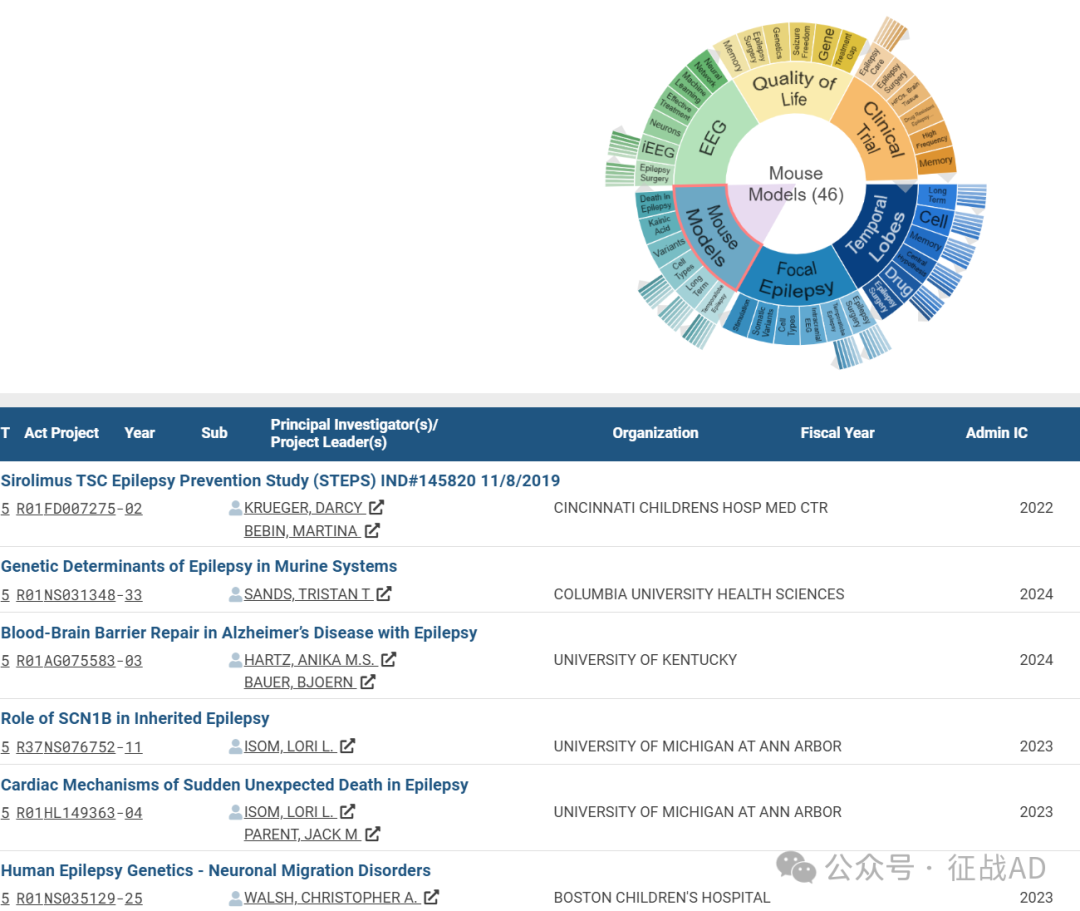
其他癫痫研究大的方向也包括EEG、生活质量(Quality of Life)、临床研究(Clinical Trail)等。
三,借鉴与突破
我们也分享在癫痫领域的几项课题摘要,希望对同仁们有所启发。
A,Epilepsy Multiplatform Variant Prediction (EpiMVP)
EpiMVP will develop a modular, highly integrated platform approach to accelerate determination of the functional, pharmacological, neuronal network and whole animal consequences of genetic variants implicated in a range of clinical epilepsy types. We will study non-ion-channel, non-receptor genes commonly implicated in epilepsy, and that are involved in diverse biological processes.
Our ultimate goals are to devise an effective experimental platform for testing the pathogenicity of VUS in genes implicated in epilepsy and to generate a computational model (EpiPred) that predicts the likelihood that a variant is pathogenic or benign. This work is crucial in the pursuit of novel therapeutics and the promise of personalized medicine.
The overall milestones of the Center are: 1. Evaluate genes associated with epilepsy and select candidates for analysis, model data for, and analyze all project data for development of EpiPred an iterative machine learning model to classify variants in genes implicated in epilepsy. 2. Test selected VUS using medium throughput, in vitro approaches. 3. Test selected VUS in human cortical neurons or human brain organoids using induced pluripotent stem cell approaches. 4. Test selected VUS in pre-clinical, in vivo models.
The expected outcomes are: 1. Provide a freely available prediction tool for clinicians to differentiate between pathogenic and benign variants for genes implicated in epilepsy; 2. Provide experimental models to study the functional consequences of specific variants; 3. Provide a reclassification of VUS in ClinVar/ClinGen and to develop new guidelines for incorporating functional readouts into the ACMG criteria; 4. Inform the future development of novel therapeutics to treat epilepsy.
B, A Phase 3 clinical trial of an e-health behavioral intervention to improve executive functioning in adolescents with epilepsy
To fill this gap, we successfully developed and tested Epilepsy Journey (EJ), a comprehensive e-health behavioral multi-component problem-solving intervention that combines 10 self-guided learning modules with 10 telehealth sessions. The promising proof-of-concept trial (n=39) showed high feasibility, acceptability, patient satisfaction, and significant improvements in parent-reported EF behaviors, neurobehavioral functioning, and quality of life.
The next logical phase of this research is to conduct a definitive randomized clinical trial to examine: 1) whether the two components of treatment (EJ modules and telehealth) are both essential, 2) if the intervention generalizes to a racially diverse sample, and 3) has a durable impact on improving parent-reported and performance-based EF behaviors. Thus, the aim of the current proposal is to conduct a multi-site Phase 3 randomized controlled clinical trial (RCT) using a 2x2 factorial design to examine the efficacy of separate (EJ modules and EJ telehealth) and combined components of EJ on EF.
Participants positive for EF deficits (n=232) will be randomized to one of four arms: 1) EJ modules with telehealth sessions, 2) EJ modules alone, 3) EJ telehealth sessions alone, or 4) Usual Care (no EJ modules or telehealth sessions). Treatment participants will either independently review EJ modules focused on EF skills (~15-30 min.) and/or have weekly telehealth sessions (~30-45 min.) with a therapist for three months. The groups will learn and apply problem-solving strategies to their individual EF difficulties. Participants will complete measures at baseline, post-treatment, 3- and 12-months post-treatment to examine maintenance of effects. There is a critical need for evidence-based interventions to improve executive functioning behaviors in youth with epilepsy. If the aims of this UG3/UH3 are achieved, we will have definitive evidence for addressing EF deficits. We expect that EJ modules and EJ telehealth will demonstrate efficacy alone and in combination, which will allow patients to select the approach best suited to their specific situation.
猜你喜欢
- 红薯蒸了吃不完能干什么 蒸红薯必须多久
- 肌肉力量恢复,症状持续改善18个月!CAR-T疗法为重症肌无力患者带来新希望
- 新冠抗原检测收费不得高于每人次15元
- 北京市疾病控制中心发布17例增加新冠肺炎诊断病案交通出行运动轨迹
- 慢性鼻炎患者在生活中需要注意什么
- Clin Implant Dent Relat Res:全弓种植体印模的校准口内扫描方案(CISP):与常规印模、口内扫描和使用扫描辅助的口内扫描的体外比较
- Br J Anaesth:平衡晶体液相较于0.9%生理盐水对肾移植患者的优势作用
- 什么是脓疱?为什么会发生脓疱?怎么治疗脓疱呢?
- 足踝生物力学基础
- 一例食管小细胞癌免疫治疗实践解读 | 免疫治疗能否破除食管小细胞癌难治魔咒?
- 搜索
-
- 1000℃西南大学/Biomaterials:可见光响应阳离子化光动力纳米颗粒整合丝素蛋白纳米纤维基质通过增强ROS利用促进感染创面愈合
- 1000℃空军军医大学Biomaterials:增强压电胶原各向异性支架通过电-拓扑协同信号促进骨骼肌再生
- 1000℃南方医科大学Biomaterials:光热-压电双响应抗菌假体界面调控施万细胞表型转化促进感染性骨缺损修复
- 1000℃南京大学Biomaterials:生物硅纳米笼可注射水凝胶捕获内源性TGF-β1用于原位透明软骨再生
- 1000℃Nat Genet | 刘斯洋/魏凤香/张铨富等绘制人类妊娠动态遗传图谱,揭示妊娠表型的特异性遗传效应
- 1000℃华南理工大学,最新Biomaterials:3D打印仿生海绵体联合间充质干细胞通过免疫微环境重塑修复雄性猪勃起功能
- 1000℃内蒙古大学AM:一种协同工程的蛋白质水凝胶,整合拓扑强化和金属离子协调,用于糖尿病伤口修复
- 1000℃同济大学附属东方医院Biomaterials:钒单原子催化剂通过GPR110依赖性巨噬细胞极化介导脓毒症肠损伤治疗
- 精J Child Psychol Psychiatry:12种罕见神经发育障碍儿童沟通能力谱系
- 精研究发现:爱吃辣的人,心血管病和癌症死亡风险都会显著降低
- 精Nursing in Critical Care:别再指责护士了!ICU 里被遗漏的护理,根源在系统而非个人
- 精Acta Obstet Gynecol Scand:罕见病女性的妊娠并发症与母婴结局,一项单中心434种罕见病的回顾性队列研究
- 精【爱儿小醉】儿科患者术前对流层臭氧暴露与围手术期呼吸系统不良事件之间的关系:一项单中心回顾性队列研究
- 精eBioMedicine:牙龈下微生物组与脑健康存在连续关联梯度,牙周炎或成认知衰退可干预靶点
- 精军事医学研究院《自然·通讯》:自适应IrPtCu纳米酶水凝胶实现耐药菌感染伤口序贯治疗
- 精能够逆转萎缩性胃炎的两个中成药,该怎么选择?
- 荐同时性多发性原发性肺癌,左右病灶分别为EGFR和ALK阳性,考虑淋巴结肿大仅局限左肺门及血浆EGFR阳性,采用奥希替尼联合化疗
- 荐40岁女性同时罹患卵巢支持细胞-间质细胞瘤和透明细胞乳头状肾肿瘤,WES等基因检测竟为阴性
- 荐椎管内麻醉使用止血药突发气道痉挛的抢救流程解析
- 荐女子肝区无任何不适,影像提示复杂囊性病变,层层鉴别后锁定罕见胆管源性囊性肿瘤
- 荐“绘”真报告 | 病理考虑为中枢神经细胞瘤,检出脑室外神经细胞瘤的特征性变异FGFR1-TACC1融合,辅助鉴别诊断
- 荐8岁女童出现男性化症状,竟是形似「性索-间质肿瘤」的卵巢「无性细胞瘤」所致,少见KRAS/CDK4共扩增或与侵袭性有关
- 荐17例病例分析揭示常见于中年人的色素性室管膜瘤临床特征与预后,分子检测可助力临床精准诊疗
- 荐Lancet Oncol:结直肠癌腹膜转移,围手术期化疗并非必选项
- 标签列表
-
- 星座 (702)
- 孩子 (526)
- 恋爱 (505)
- 婴儿车 (390)
- 宝宝 (328)
- 狮子座 (313)
- 金牛座 (313)
- 摩羯座 (302)
- 白羊座 (301)
- 天蝎座 (294)
- 巨蟹座 (289)
- 双子座 (289)
- 处女座 (285)
- 天秤座 (276)
- 双鱼座 (268)
- 婴儿 (265)
- 水瓶座 (260)
- 射手座 (239)
- 不完美妈妈 (173)
- 跳槽那些事儿 (168)
- baby (140)
- 女婴 (132)
- 生肖 (129)
- 女儿 (129)
- 民警 (127)
- 狮子 (105)
- NBA (101)
- 家长 (97)
- 怀孕 (95)
- 儿童 (93)
- 交警 (89)
- 孕妇 (77)
- 儿子 (75)
- Angelababy (74)
- 父母 (74)
- 幼儿园 (73)
- 医院 (69)
- 童车 (66)
- 女子 (60)
- 郑州 (58)