首页 > 医疗资讯/ 正文
囊性纤维化(Cystic Fibrosis, CF)是一种遗传性疾病,主要影响身体的分泌腺,包括呼吸系统、消化系统和生殖系统的腺体。这种疾病导致身体分泌出来的粘液异常粘稠和黏滞,堵塞管道,引起感染和炎症。
尽管近年来在囊性纤维化的诊断和治疗方面取得了显著进展,但仍存在一些重要而未解决的临床问题:
-
治疗方法限制:虽然近年来针对CFTR基因突变的治疗方法有所进展,例如高效的CFTR调节剂,但这些治疗方法成本高昂,且不是所有CF患者都适用。
-
耐药性问题:由于反复肺部感染,患者可能对抗生素产生耐药性,治疗感染变得更加困难。
-
长期并发症:囊性纤维化的患者随着年龄增长,可能会发展出严重的并发症,如肺功能逐渐下降、糖尿病和骨质疏松等。
-
全面治疗和生活质量改善:尽管治疗方法在进步,但如何改善患者的整体生活质量,包括心理健康和社会参与,仍需更多关注和研究。
囊性纤维化的治疗需要综合考虑药物治疗、物理治疗、营养支持和心理社会干预等多方面方法,以减轻症状、延缓病程进展和提高生活质量。此外,针对基因治疗的研究也在不断进行中,希望未来能够根治或大幅改善此病。
我们仅对美国国立卫生研究院(NIH)资助的在研囊性纤维化相关项目进行梳理,希望给同仁们的选题思路提供一点启发。
2024年,以“Cystic Fibrosis”为检索词、在题目中进行检索,美国NIH针对囊性纤维化的在研有84项。
一,谁获得了这些研究?
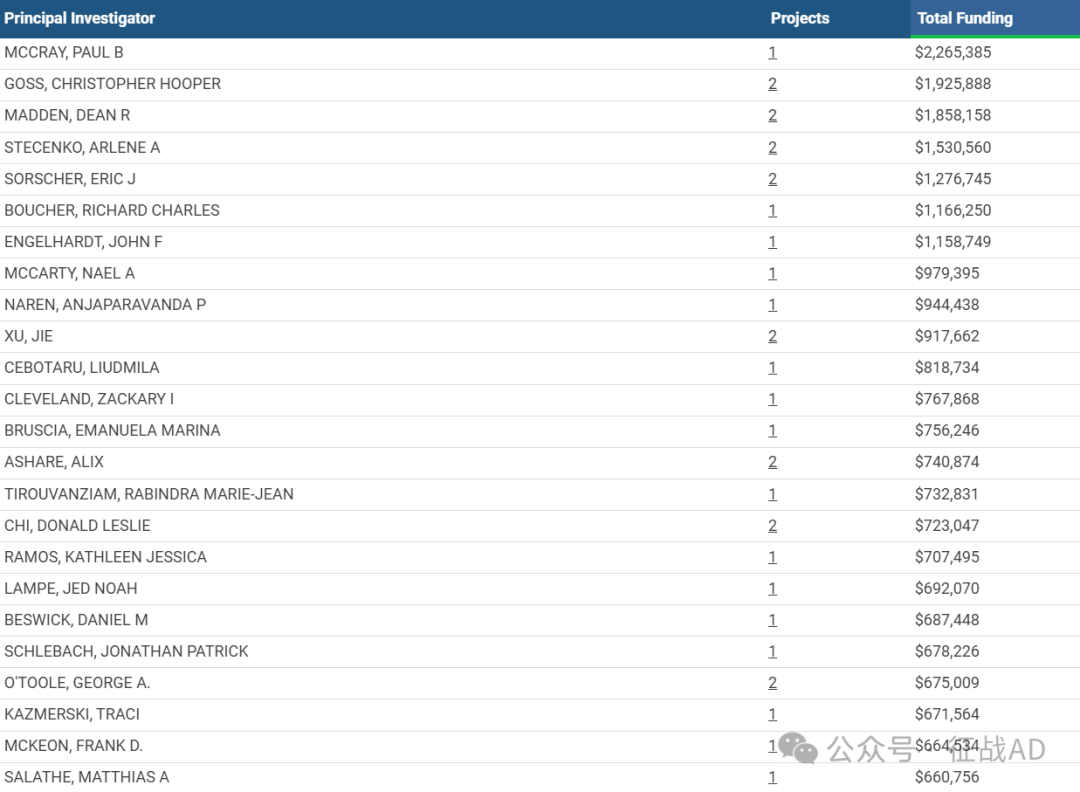
1,在研囊性纤维化基金最多的PI
-
UNIVERSITY OF IOWA 的 MCCRAY, PAUL B
-
SEATTLE CHILDREN'S HOSPITAL 的 GOSS, CHRISTOPHER HOOPER
-
DARTMOUTH COLLEGE 的 MADDEN, DEAN R
-
EMORY UNIVERSITY 的 STECENKO, ARLENE A
-
EMORY UNIVERSITY 的 SORSCHER, ERIC J
2,囊性纤维化基金最多的研究机构
-
埃默里大学
-
爱荷华大学
-
达特茅斯学院
-
西雅图儿童医院
-
华盛顿大学等

二,囊性纤维化研究热点是什么?
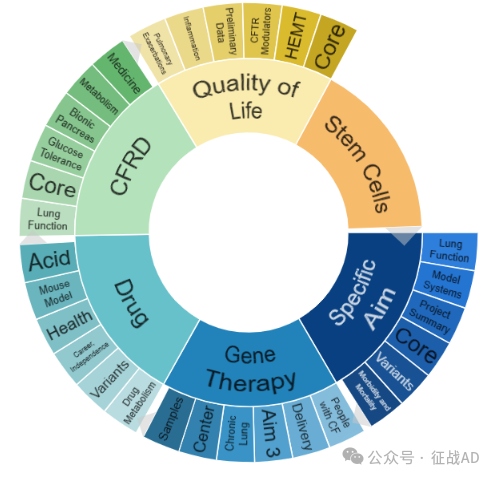
囊性纤维化研究领域总览(根据关键词)
A,关于具体目标(Specefic Aims)的研究项目最多
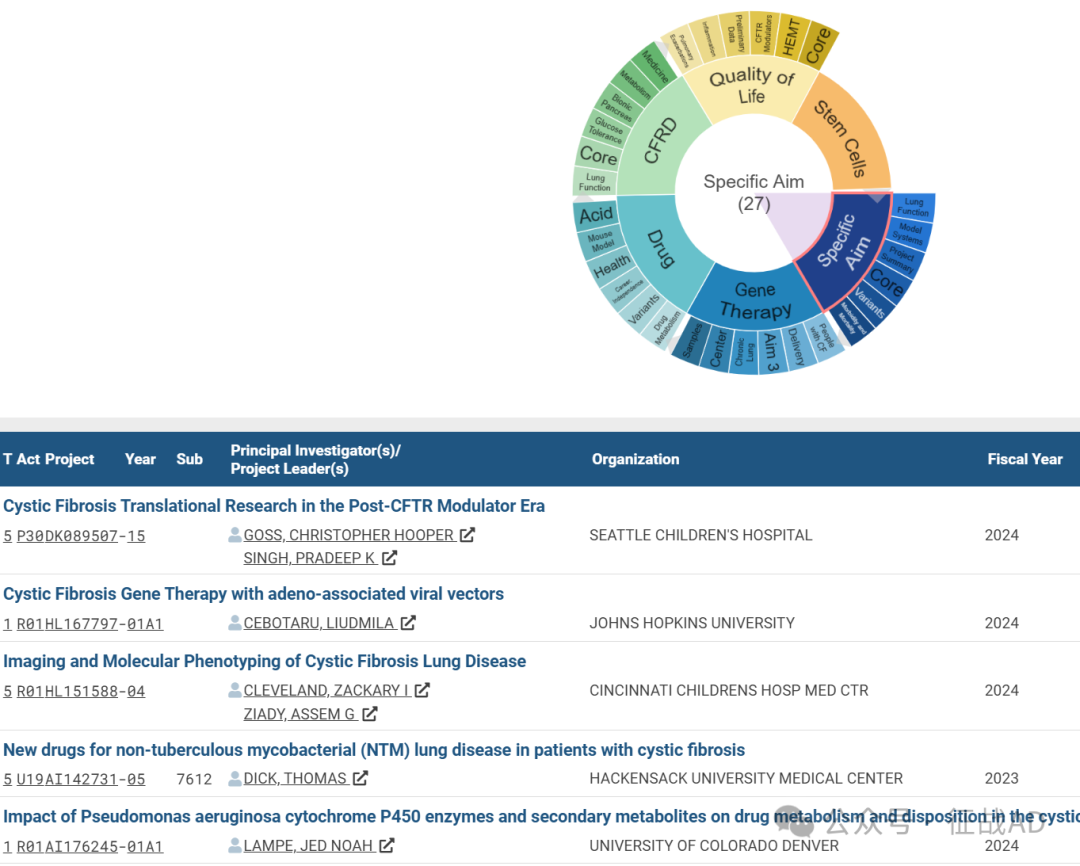
有 27 项在研基金涉及到了具体目标,关注最多的方面包括肺功能(Lung Function)、模型系统(Model Systems)、项目概要(Project Summary)、核心(Core)、变异(Variants)、发病率和死亡率(Morbidity and Mortality)等方面研究。
B,基因疗法(Gene Therapy)的研究
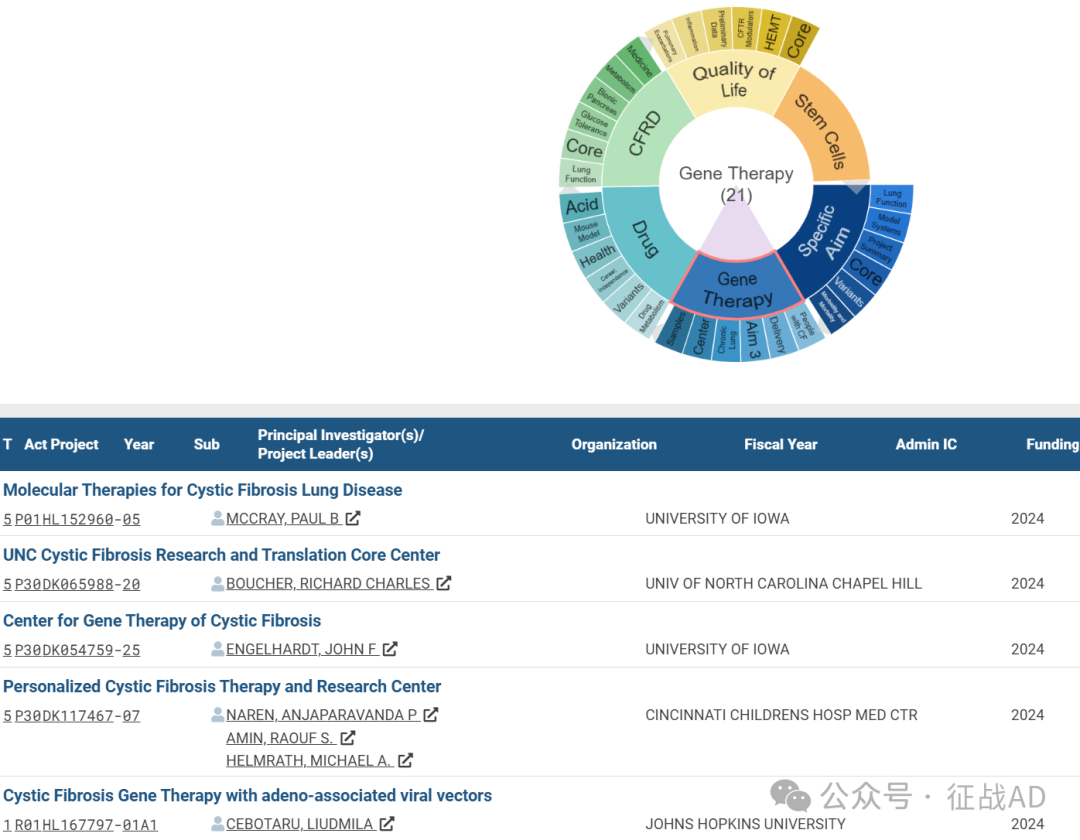
有 21 项研究涉及到基因疗法,研究领域主要涉及囊性纤维病患者(People with CF)、递送(Delivery)、慢性肺(Chronic Lung)、中心(Center)、样本(Samples)等方面研究。
C,药物(Drug)
有 21 项研究涉及到药物,涉及的关键词包括如药物代谢(Drug Metabolism)、变异(Variants)、职业独立性(Career Independence)、健康(Health)、小鼠模型(Mouse Model)、酸(Acid)等。
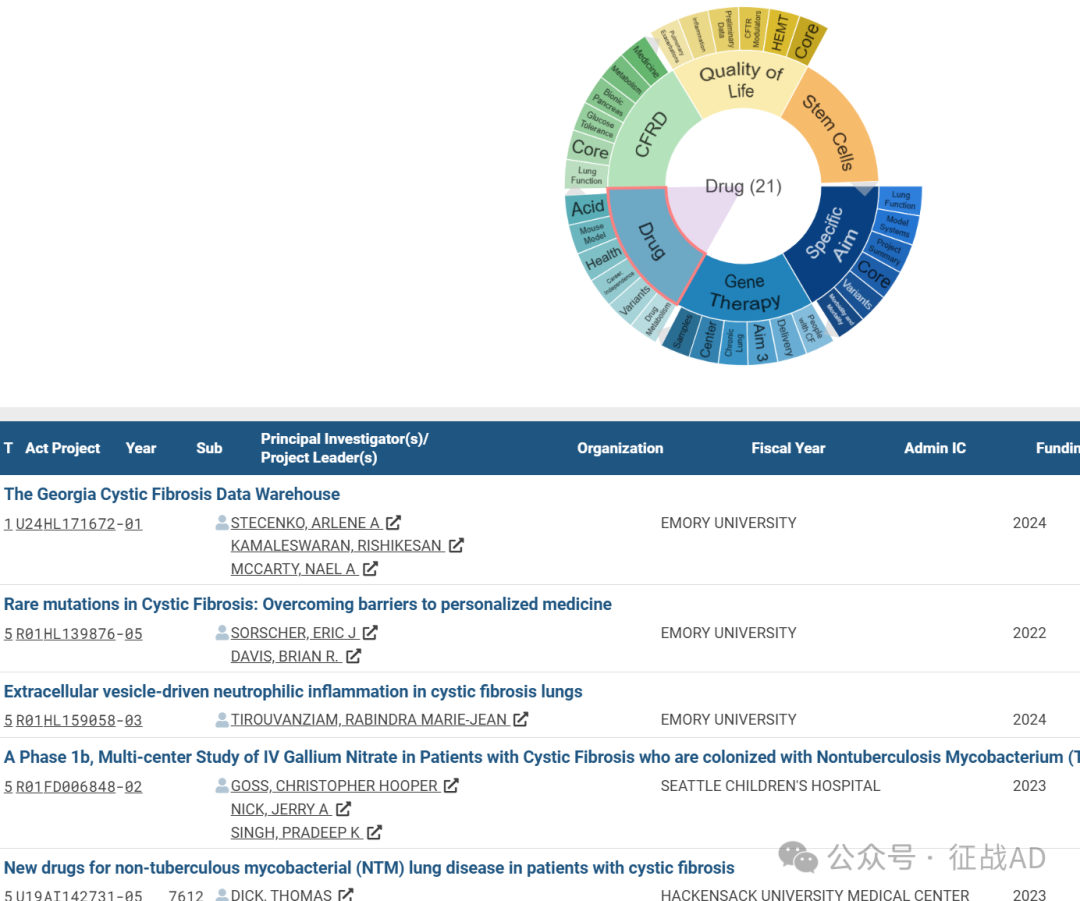
其他囊性纤维化研究大的方向也包括CFRD、干细胞(Stem Cells)、生活质量(Quality of Life)等。
三,借鉴与突破
我们也分享在囊性纤维化领域的几项课题摘要,希望对同仁们有所启发。
A,Molecular Therapies for Cystic Fibrosis Lung Disease
The central theme of this proposal is developing new molecular therapies to prevent or treat CF lung disease. The goal of our three projects and four cores is to exploit the power of our in vitro and animal models to address questions fundamental to lung disease pathogenesis and to use this knowledge to inform new therapeutic strategies to complement CF defects, including gene repair and the addition of a small molecule that forms anion channels.
The three closely interrelated Projects will work together to accomplish the following goals:
1) To restore CFTR function using targeted single nucleotide editing. We hypothesize that cells in the surface airway epithelium, including those with progenitor capacity, can be targeted to repair CFTR mutations using base editing.
2) To understand the mechanisms of amphotericin B (AmB)-induced anion secretion in airway epithelia and to test the hypothesis that AmB can restore CF host defenses in vivo. AmB is a small molecule that forms anion channels.
3) To determine how CFTR expression in pulmonary ionocytes and ciliated cells regulates properties of the airway surface liquid that are crucial for clearance and innate immunity.
B, Cystic Fibrosis Gene Therapy with adeno-associated viral vectors
To further explore the potential usefulness of gene therapy for CF, we will use Rhesus macaques to explore the toxicology and pharmacology of AAV1-CBΔ27-264. We will use a ferret model bearing the F508 mutation to evaluate rescue of the CF phenotype in a large animal model. This model is ideal for our studies because ferrets show a tropism for AAV1 similar to that of humans and monkeys, and the disease phenotype can be switched on and off following application or cessation CFTR corrector/potentiator treatment. Finally, we will conduct a phase I clinical trial in patients bearing the F508 mutation.
We propose three overall Specific Aims:
Aim I: To evaluate single-dose administration of AAV1-Δ27-264CFTR to Rhesus macaques.
Aim 2: To determine the therapeutic effects of AAV1 vectors containing truncated CFTR in F508-del Ferrets.
Aim 3: To determine whether dosing with an AAV1 vector containing a truncated CFTR will lead to transduc- tion in ferret and human primary airway cells.
The overarching questions for CF gene therapy are whether gene transduction can rescue the CF phenotype and how long the therapeutic effect will last before a repeated administration is necessary. The answers to these practical questions have enormous clinical consequences for the development of effective CF gene therapy. This application will address the extent to which an AAV1 vector containing AAV1-CBΔ27-264 will be effective in rescuing the CF phenotype and how long the rescue will last.
Significance: CF is an autosomal disease that leads to significant morbidity and mortality in patients with the disorder. The work is significant because it will address the safety and efficacy of CFTR delivery via AAV1 viral vectors to lung and to demonstrate CFTR expression.
- 搜索
-
- 1000℃西南大学/Biomaterials:可见光响应阳离子化光动力纳米颗粒整合丝素蛋白纳米纤维基质通过增强ROS利用促进感染创面愈合
- 1000℃空军军医大学Biomaterials:增强压电胶原各向异性支架通过电-拓扑协同信号促进骨骼肌再生
- 1000℃南方医科大学Biomaterials:光热-压电双响应抗菌假体界面调控施万细胞表型转化促进感染性骨缺损修复
- 1000℃南京大学Biomaterials:生物硅纳米笼可注射水凝胶捕获内源性TGF-β1用于原位透明软骨再生
- 1000℃Nat Genet | 刘斯洋/魏凤香/张铨富等绘制人类妊娠动态遗传图谱,揭示妊娠表型的特异性遗传效应
- 1000℃华南理工大学,最新Biomaterials:3D打印仿生海绵体联合间充质干细胞通过免疫微环境重塑修复雄性猪勃起功能
- 1000℃内蒙古大学AM:一种协同工程的蛋白质水凝胶,整合拓扑强化和金属离子协调,用于糖尿病伤口修复
- 1000℃同济大学附属东方医院Biomaterials:钒单原子催化剂通过GPR110依赖性巨噬细胞极化介导脓毒症肠损伤治疗
- 精J Child Psychol Psychiatry:12种罕见神经发育障碍儿童沟通能力谱系
- 精研究发现:爱吃辣的人,心血管病和癌症死亡风险都会显著降低
- 精Nursing in Critical Care:别再指责护士了!ICU 里被遗漏的护理,根源在系统而非个人
- 精Acta Obstet Gynecol Scand:罕见病女性的妊娠并发症与母婴结局,一项单中心434种罕见病的回顾性队列研究
- 精【爱儿小醉】儿科患者术前对流层臭氧暴露与围手术期呼吸系统不良事件之间的关系:一项单中心回顾性队列研究
- 精eBioMedicine:牙龈下微生物组与脑健康存在连续关联梯度,牙周炎或成认知衰退可干预靶点
- 精军事医学研究院《自然·通讯》:自适应IrPtCu纳米酶水凝胶实现耐药菌感染伤口序贯治疗
- 精能够逆转萎缩性胃炎的两个中成药,该怎么选择?
- 荐同时性多发性原发性肺癌,左右病灶分别为EGFR和ALK阳性,考虑淋巴结肿大仅局限左肺门及血浆EGFR阳性,采用奥希替尼联合化疗
- 荐40岁女性同时罹患卵巢支持细胞-间质细胞瘤和透明细胞乳头状肾肿瘤,WES等基因检测竟为阴性
- 荐椎管内麻醉使用止血药突发气道痉挛的抢救流程解析
- 荐女子肝区无任何不适,影像提示复杂囊性病变,层层鉴别后锁定罕见胆管源性囊性肿瘤
- 荐“绘”真报告 | 病理考虑为中枢神经细胞瘤,检出脑室外神经细胞瘤的特征性变异FGFR1-TACC1融合,辅助鉴别诊断
- 荐8岁女童出现男性化症状,竟是形似「性索-间质肿瘤」的卵巢「无性细胞瘤」所致,少见KRAS/CDK4共扩增或与侵袭性有关
- 荐17例病例分析揭示常见于中年人的色素性室管膜瘤临床特征与预后,分子检测可助力临床精准诊疗
- 荐Lancet Oncol:结直肠癌腹膜转移,围手术期化疗并非必选项
- 标签列表
-
- 星座 (702)
- 孩子 (526)
- 恋爱 (505)
- 婴儿车 (390)
- 宝宝 (328)
- 狮子座 (313)
- 金牛座 (313)
- 摩羯座 (302)
- 白羊座 (301)
- 天蝎座 (294)
- 巨蟹座 (289)
- 双子座 (289)
- 处女座 (285)
- 天秤座 (276)
- 双鱼座 (268)
- 婴儿 (265)
- 水瓶座 (260)
- 射手座 (239)
- 不完美妈妈 (173)
- 跳槽那些事儿 (168)
- baby (140)
- 女婴 (132)
- 生肖 (129)
- 女儿 (129)
- 民警 (127)
- 狮子 (105)
- NBA (101)
- 家长 (97)
- 怀孕 (95)
- 儿童 (93)
- 交警 (89)
- 孕妇 (77)
- 儿子 (75)
- Angelababy (74)
- 父母 (74)
- 幼儿园 (73)
- 医院 (69)
- 童车 (66)
- 女子 (60)
- 郑州 (58)