首页 > 医疗资讯/ 正文
肾移植(Kidney Transplant)是一种治疗严重肾功能衰竭或终末期肾病(ESRD)的外科手术方法。在此手术中,一颗健康的肾脏从供体转移到患者体内,以取代患者失功能的肾脏。肾移植通常被视为比长期透析更优的治疗选择,因为它可以提供更高质量的生活和更佳的生存率。
【未解决的临床问题】
-
供体短缺:需求远远超过供应,许多患者可能需要等待多年才能进行肾移植。
-
排斥反应:即便是在良好匹配和管理下,长期的免疫抑制治疗也可能导致严重的副作用,如感染和肿瘤风险增加。
-
药物副作用和管理:免疫抑制药物虽然可以防止排斥,但长期使用可能对心血管健康等产生负面影响。
-
移植后监测和治疗:需要持续监控患者的药物水平、肾功能和其他健康指标,确保移植肾的健康和功能。
-
再次移植的复杂性:对于第一次移植失败的患者,再次移植涉及更多的复杂性和风险。
肾移植领域的未来研究重点包括改善免疫抑制策略,减少慢性排斥和延长移植肾存活时间,以及开发替代供体来源如干细胞和生物工程肾脏。此外,提高供体的可用性和质量,优化患者匹配和选择流程也是持续关注的重点。
我们仅对美国国立卫生研究院(NIH)资助的在研肾移植相关项目进行梳理,希望给同仁们的选题思路提供一点启发。
2024年,以“Kidney Transplant”为检索词、在题目中进行检索,美国NIH针对肾移植的在研有42项。
一,谁获得了这些研究?
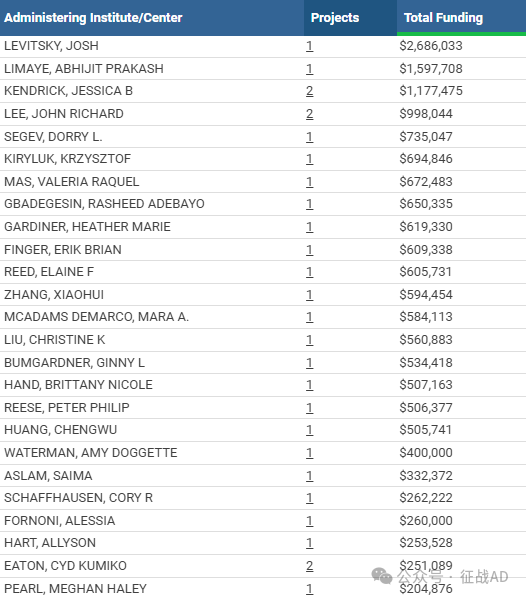
1,在研肾移植基金最多的PI
-
NORTHWESTERN UNIVERSITY AT CHICAGO 的 LEVITSKY, JOSH
-
UNIVERSITY OF WASHINGTON 的 LIMAYE, ABHIJIT PRAKASH
-
UNIVERSITY OF COLORADO DENVER 的 KENDRICK, JESSICA B
-
WEILL MEDICAL COLL OF CORNELL UNIV 的 LEE, JOHN RICHARD
-
NEW YORK UNIVERSITY SCHOOL OF MEDICINE 的 SEGEV, DORRY L.
2,肾移植课题最多的研究机构
-
纽约大学医学院
-
科罗拉多大学丹佛分校
-
亨内平医疗研究所
-
约翰霍普金斯大学
-
帕洛阿尔托退伍军人研究所等。

二,肾移植研究热点是什么?
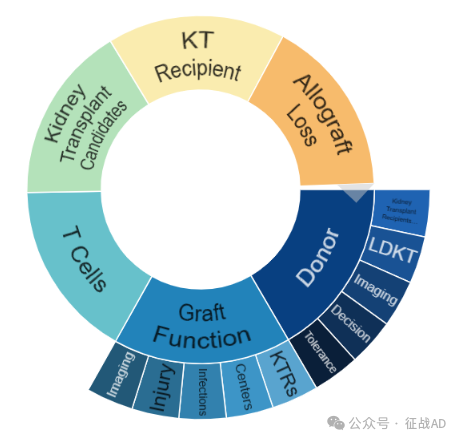
肾移植研究领域总览(根据关键词)
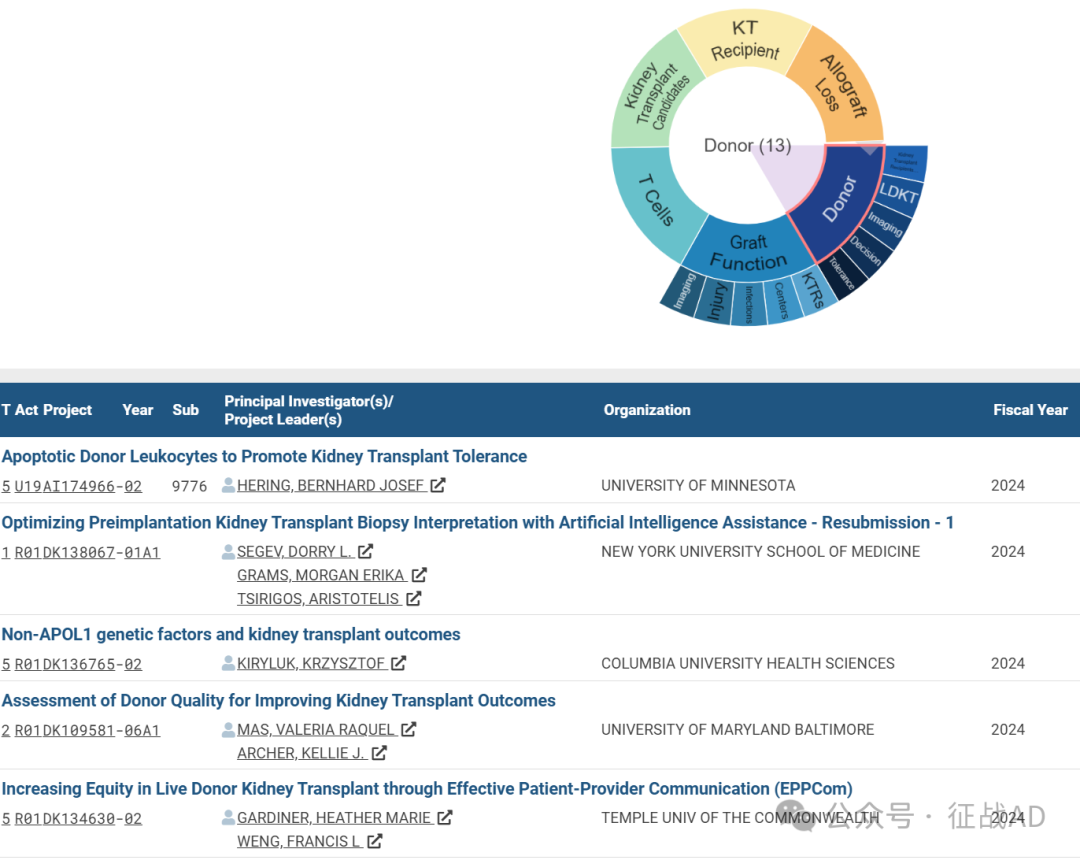
A,关于捐助者(Donor)的研究项目最多
有 13 项在研基金涉及到了捐助者,关注最多的方面包括肾移植患者(Kidney Transplant Recipients)、LDKT、影像(Imaging)、决策(Decision)、耐受性(Tolerance)等方面研究。
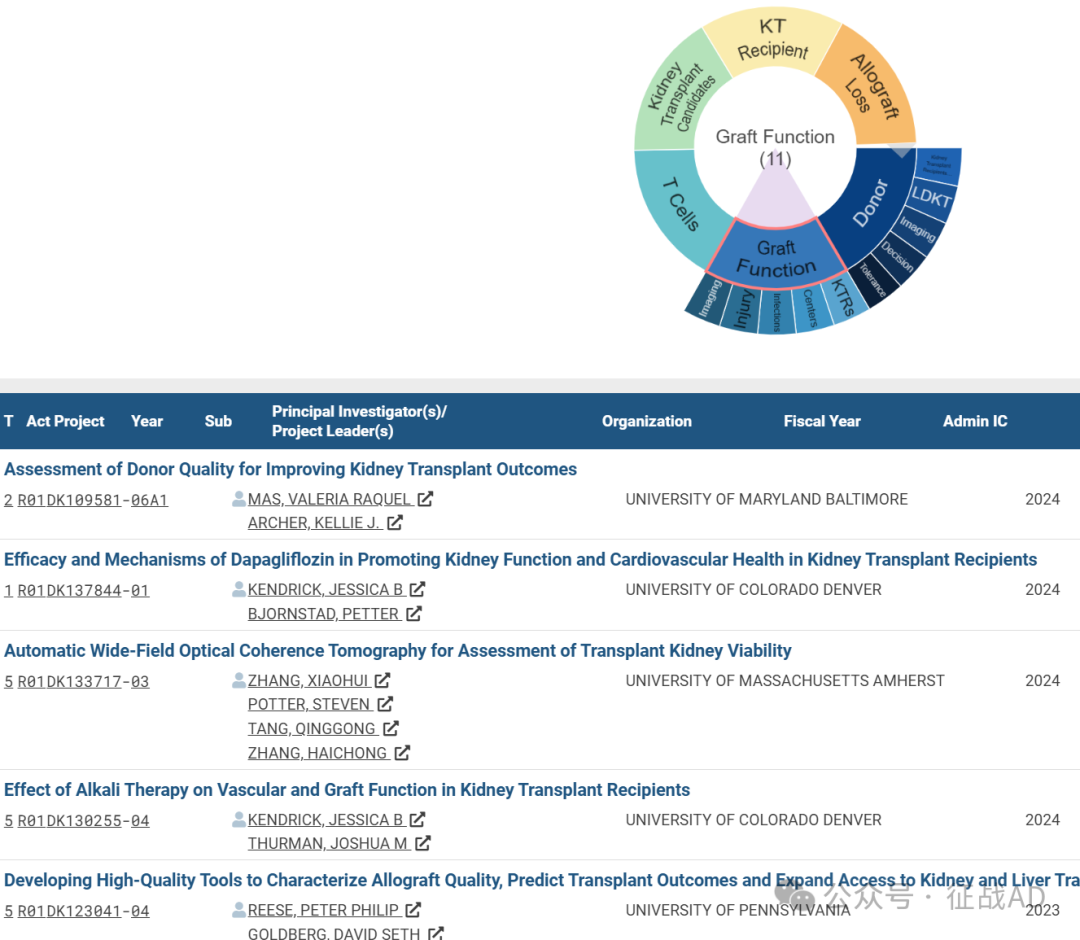
B,移植物功能(Graft Function)的研究
有 11 项研究涉及到移植物功能,研究领域主要涉及关键技术参数(KTRs)、中心(Centers)、感染(Infections)、损伤(Injury)、影像(Imaging)等方面研究。
其他肾移植研究大的方向也包括T细胞(T Cell)、肾移植候选人(Kidney Transplant Candidates)、肾移植接受者(KT Recipient)、同种异体移植失败(Allograft Loss)等。
三,借鉴与突破
我们也分享在肾移植领域的几项课题摘要,希望对同仁们有所启发。
A,Non-APOL1 genetic factors and kidney transplant outcomes
This is an ancillary study to the prospective APOLLO (APOL1 Long-term Kidney Transplantation Outcomes) cohort of 2,800 kidney transplant donor-recipient pairs. The parent study aims to test the impact of APOL1 risk genotypes on kidney transplantation outcomes. Here, we propose to test the role of additional genetic factors other than APOL1 in determining allograft outcomes. Accordingly, we propose to expand the scope of the APOLLO study to generate high-quality genome-wide SNP and exome sequence data for all 2,800 donor- recipient pairs enrolled by the network. Our proposal addresses the existing disparities in research and clinical care, since African-ancestry patients with end stage kidney disease are currently under-represented in genetic studies and have worse transplantation outcomes compared to non-African ancestry patients.
Our overarching hypothesis is that there are multiple additional genetic factors in this population that convey the risk of allograft loss independently of APOL1. Our recent work clearly demonstrates that polygenic background and APOL1 risk genotypes have additive effects on the risk of kidney disease in individuals of African ancestry. Our newly proposed genome-wide polygenic score (GPS) combining polygenic and APOL1 risk provided substantially improved prediction of kidney disease. There is now an urgent need to test whether combining donor polygenic and APOL1 risk improves the prediction of allograft outcomes. Additionally, our proposed generation of genome-wide genetic data will facilitate unbiased scans for specific APOL1 modifiers with an effect on graft survival. Lastly, the APOLLO study provides us with a unique opportunity to perform genetic compatibility scans in full donor-recipient pairs. We aim to test our original “genomic collision” hypothesis at the LIMS1 locus under which the recipients carrying gene-disrupting variants are at a higher risk of rejection when exposed to a graft expressing intact gene products. We will then expand this hypothesis to various types of genetic variation genome-wide, including gene-disrupting copy number variants, predicted loss-of-function variants, and even missense variants. Any positive findings from our discovery studies will be tested for validation in the ancestrally diverse international cohorts of the iGeneTRAiN consortium.
B, Microbial Biomarkers for Diagnosing and Predicting Infections in Kidney Transplant Recipients
The long term goal of this study is to develop comprehensive microbial biomarkers in the stool, blood, and the urine for diagnosing and predicting infections in kidney transplant recipients.
Our objectives are: 1) Develop a fecal SCFA assay that predicts the risk for infections 2) Develop blood and urine cfDNA assays that can comprehensively diagnose infections as well as predict the risk for infections. These objectives are inspired by observations from several recent pilot studies: 1) We have found that the fecal abundance of short- chain fatty acid (SCFA) producing bacteria is associated with decreased future development of bacterial and viral infections 2) We have demonstrated that cell-free DNA (cfDNA) profiling in the blood and in the urine can simultaneously detect changes in the microbiome and virome over time and detect infections in transplant recipients. Importantly, with respect to cfDNA profiling, we have developed a novel technique called SIFT-seq to overcome the challenge of environmental contamination in low biomass specimens. By biochemically tagging the biological specimen prior to downstream DNA isolation, we can bioinformatically remove DNA introduced during sample preparation and accurately identify the microbiome and virome in low biomass specimens.
In this study, we propose to recruit 300 kidney transplant recipients at the time of transplantation for serial fecal, urine, and blood specimen collections during the first year after transplantation. We will profile the gut microbiome using metagenomic sequencing to identify taxa at the species level and using metabolomic SCFA profiling. In addition, we will profile the blood and urine specimens using our novel technique, SIFT-seq, to identify the blood and urine microbiome and virome with high sensitivity and specificity.
In Aim 1, we will determine the fecal bacterial and SCFA profiles that predict the risk of infections in kidney transplant recipients. In Aim 2, we will determine the blood and urine cfDNA profiles that are diagnostic and predictive of infections in kidney transplant recipients.
猜你喜欢
- 桃子硬的情况下吃完如何 桃子为什么有的硬有的软
- Trop2 ADC药物戈沙妥珠单抗治疗肺癌III期临床获成功(TROPiCS-02研究)
- 浙江省经食管心脏电生理技术操作与诊断规范(2021 修订版)
- 如何判断性生活的质量?这样能提高性生活质量
- 2024 ESMO BC | HER2阳性早期或局部晚期乳腺癌的新辅助治疗:吡咯替尼联合曲妥珠单抗、白蛋白紫杉醇和卡铂的单一臂II期临床试验(编号317)
- 男子被蜱虫咬后染病毒进ICU 被蜱虫叮咬后怎么处理
- 人体的哪些部位一碰就会沸腾
- 日本东京发生5.5级地震 地震后多少小时内为最佳救援时间
- 温州市瓯海区第三人民医院宫腔镜设备招标公告
- 哪些习惯让甲状腺越来越年轻?一起来看关于甲状腺健康那些事
- 搜索
-
- 1000℃西南大学/Biomaterials:可见光响应阳离子化光动力纳米颗粒整合丝素蛋白纳米纤维基质通过增强ROS利用促进感染创面愈合
- 1000℃空军军医大学Biomaterials:增强压电胶原各向异性支架通过电-拓扑协同信号促进骨骼肌再生
- 1000℃南方医科大学Biomaterials:光热-压电双响应抗菌假体界面调控施万细胞表型转化促进感染性骨缺损修复
- 1000℃南京大学Biomaterials:生物硅纳米笼可注射水凝胶捕获内源性TGF-β1用于原位透明软骨再生
- 1000℃Nat Genet | 刘斯洋/魏凤香/张铨富等绘制人类妊娠动态遗传图谱,揭示妊娠表型的特异性遗传效应
- 1000℃华南理工大学,最新Biomaterials:3D打印仿生海绵体联合间充质干细胞通过免疫微环境重塑修复雄性猪勃起功能
- 1000℃内蒙古大学AM:一种协同工程的蛋白质水凝胶,整合拓扑强化和金属离子协调,用于糖尿病伤口修复
- 1000℃同济大学附属东方医院Biomaterials:钒单原子催化剂通过GPR110依赖性巨噬细胞极化介导脓毒症肠损伤治疗
- 精J Child Psychol Psychiatry:12种罕见神经发育障碍儿童沟通能力谱系
- 精研究发现:爱吃辣的人,心血管病和癌症死亡风险都会显著降低
- 精Nursing in Critical Care:别再指责护士了!ICU 里被遗漏的护理,根源在系统而非个人
- 精Acta Obstet Gynecol Scand:罕见病女性的妊娠并发症与母婴结局,一项单中心434种罕见病的回顾性队列研究
- 精【爱儿小醉】儿科患者术前对流层臭氧暴露与围手术期呼吸系统不良事件之间的关系:一项单中心回顾性队列研究
- 精eBioMedicine:牙龈下微生物组与脑健康存在连续关联梯度,牙周炎或成认知衰退可干预靶点
- 精军事医学研究院《自然·通讯》:自适应IrPtCu纳米酶水凝胶实现耐药菌感染伤口序贯治疗
- 精能够逆转萎缩性胃炎的两个中成药,该怎么选择?
- 荐同时性多发性原发性肺癌,左右病灶分别为EGFR和ALK阳性,考虑淋巴结肿大仅局限左肺门及血浆EGFR阳性,采用奥希替尼联合化疗
- 荐40岁女性同时罹患卵巢支持细胞-间质细胞瘤和透明细胞乳头状肾肿瘤,WES等基因检测竟为阴性
- 荐椎管内麻醉使用止血药突发气道痉挛的抢救流程解析
- 荐女子肝区无任何不适,影像提示复杂囊性病变,层层鉴别后锁定罕见胆管源性囊性肿瘤
- 荐“绘”真报告 | 病理考虑为中枢神经细胞瘤,检出脑室外神经细胞瘤的特征性变异FGFR1-TACC1融合,辅助鉴别诊断
- 荐8岁女童出现男性化症状,竟是形似「性索-间质肿瘤」的卵巢「无性细胞瘤」所致,少见KRAS/CDK4共扩增或与侵袭性有关
- 荐17例病例分析揭示常见于中年人的色素性室管膜瘤临床特征与预后,分子检测可助力临床精准诊疗
- 荐Lancet Oncol:结直肠癌腹膜转移,围手术期化疗并非必选项
- 标签列表
-
- 星座 (702)
- 孩子 (526)
- 恋爱 (505)
- 婴儿车 (390)
- 宝宝 (328)
- 狮子座 (313)
- 金牛座 (313)
- 摩羯座 (302)
- 白羊座 (301)
- 天蝎座 (294)
- 巨蟹座 (289)
- 双子座 (289)
- 处女座 (285)
- 天秤座 (276)
- 双鱼座 (268)
- 婴儿 (265)
- 水瓶座 (260)
- 射手座 (239)
- 不完美妈妈 (173)
- 跳槽那些事儿 (168)
- baby (140)
- 女婴 (132)
- 生肖 (129)
- 女儿 (129)
- 民警 (127)
- 狮子 (105)
- NBA (101)
- 家长 (97)
- 怀孕 (95)
- 儿童 (93)
- 交警 (89)
- 孕妇 (77)
- 儿子 (75)
- Angelababy (74)
- 父母 (74)
- 幼儿园 (73)
- 医院 (69)
- 童车 (66)
- 女子 (60)
- 郑州 (58)